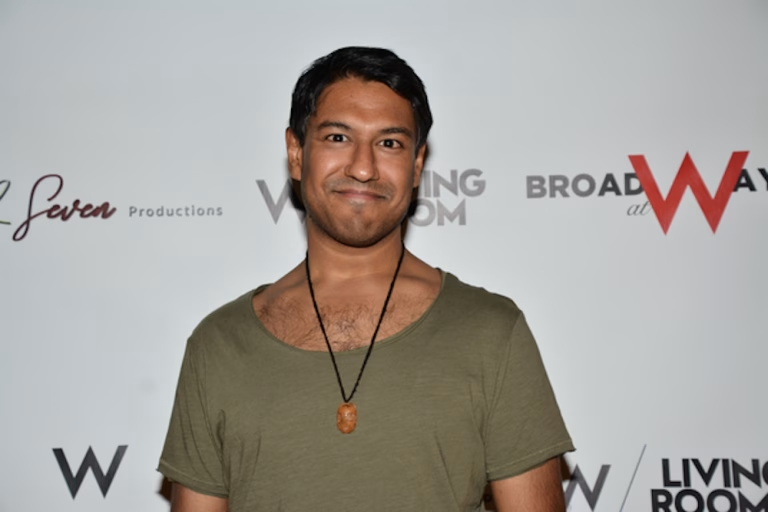
Vishal Vaidya and I have been friends since we were kids, and this conversation was the first time we’d really caught up in nearly a decade. (Our first interview was back in 2017, right after his first Broadway show.)
Since then he’s been in Groundhog Day and Merrily We Roll Along on Broadway (the second one is streaming on Netflix), worked with Jonathan Groff, Daniel Radcliffe, and Lindsay Mendez, played Ajit in Come Fall in Love (the Dilwale Dulhania Le Jayenge musical) at The Old Globe, and starred in the world premiere of The Lunchbox at Berkeley Repertory Theatre. He also runs a private voice teaching practice and has partnered with Broadway for Arts Education.
We talked about building a creative life on your own terms, how the model minority myth shaped the way we were raised to think about achievement, and what he’d tell the Brown kids sitting in the same classrooms we sat in. (You can also listen on Spotify.)

Recorded June 2026.
In this episode
- What success means to him now (finding joy in the work on the day)
- Unlearning approval-seeking in a field built on approval
- Why “alignment” lets him say no
- What chasing teacher approval cost him
- How things have changed for South Asian actors in musical theater
- “Creativity is a way of life”
Vishal Vaidya on what success means
When we talked in 2017 he was fresh off his first Broadway show and running at full sprint. Nearly a decade later (a ton of great work, coming out publicly, getting married), success looks different. So I asked him what it means to him now.
“With my career, success is about finding joy in the work I’m doing on the day…
Vishal Vaidya
But what I’ve learned is to trust my gut — and leading with that is what success means to me.”
He’s chasing alignment now instead of accolades, which also means he gets to say no.
Vishal Vaidya on approval-seeking, and unlearning it
Vishal works in a field that runs on other people’s approval: auditioning, being evaluated, getting picked or not. We spent a long time on how you live like that without losing yourself.
“I got to a point where I was like, I can’t seek approval from others. I have to lead with approval of myself… If you’re seeking approval, you’re going to want to be nice so that people will like you, but actually that might diffuse the work you’re actually doing.”
Vishal Vaidya
That shift means he walks into auditions with “here’s what I have to offer” instead of “please approve of me,” and the roles he takes now actually fit.
“Opportunities need to be in alignment for me. That’s not true for everyone. But for me, it’s the alignment — and it’s allowed me to say no to more things, which is great.”
Vishal Vaidya
(Related: Jyoti Chand (Mamajotes) on building a creative career on your own terms)
On the model minority myth, and what school didn’t teach him
We also talked about the model minority myth. He was a good student, but chasing teacher approval came at a cost:
“Academic success has so little to do with life. I know so many people who maybe got Bs and Cs in school but are able to go about so much of life with their own willpower, whereas I spent a long time not having frameworks for what I actually need to succeed, because I was always chasing the deadline, the teacher’s approval.”
Vishal Vaidya
(Related: what teachers should know about supporting South Asian American students)
Vishal on South Asian representation in theater, and what The Lunchbox means
A lot has changed since 2017, when things were genuinely narrow for South Asian actors in musical theater:
“Post-pandemic, there are all these younger actors who are Brown, who sing, who dance, who are so talented, who are funny. And it’s been really cool to witness.”
Vishal Vaidya
The Lunchbox (based on Ritesh Batra’s 2013 film) needed a very specific, intense skill set, and Vishal says it could only happen now. Years ago, the talent pool might not have been big enough. But he’s still waiting for the “big commercial thing,” a long-running Broadway show that could be a training ground for South Asian artists the way Wicked or Book of Mormon has been for others.
But he’s no longer holding his breath for it to validate him.
“Creativity is a way of life”—what he’d tell creative South Asian American kids
His advice for creative South Asian American kids surprised me:
“The path doesn’t have to be solely a creative path to be creative. Creativity is a way of life, not necessarily a path of monetization or a job path. Do it all and see what your instincts tell you is the right path.”
Vishal Vaidya
He pointed to people in his own Lunchbox cast: an actor who finished medical school before deciding to perform, and a music director who used to be a lawyer.
“When you’re young, putting pressure on yourself to decide what you’re going to do for the rest of your life is not fair to you. Your identity is so expansive. Find creativity in everything you do.”
Vishal Vaidya
What he wishes educators knew about their Brown students
“It’s not either or — it’s yes and.
Vishal Vaidya
Coming from Brown cultures does not mean you’re not American. It just means you have two cultures. And it’s a gift, actually, to have both. In learning about the cultures of your students, you might be helping everyone. It’s an asset to everyone to learn about everyone’s cultures.”
Links from the episode
- This episode on Spotify
- Vishal Vaidya in 2017: Groundhog Day and growing up in Maryland
- Neema Sharma, who worked on the film of The Lunchbox
- Jyoti Chand (Mamajotes) on building a creative career on your own terms
Questions
Who is Vishal Vaidya?
Vishal Vaidya is a Broadway actor and voice teacher who has performed in Groundhog Day and Merrily We Roll Along on Broadway, played Ajit in Come Fall in Love (the Dilwale Dulhania Le Jayenge musical) at The Old Globe, and stars in the world premiere of The Lunchbox at Berkeley Repertory Theatre.