In 2017, I completed my Doctor of Education at Johns Hopkins University through their online doctorate program through the JHU School of Education. This marked the conclusion of several years of doctoral research on South Asian American students’ experiences in K-12 schools.
A quick aside about my work: My research examined how teacher cultural competence, perceptions shaped by the model minority myth, and everyday classroom practices influence the academic and social experiences of South Asian American students. My findings suggest that low cultural proficiency among educators can contribute to reduced support for these students. I’ve written about the research itself elsewhere on this site
(→ Explore the research findings)
…but here, I want to discuss how I actually survived the program. Doing an online doctorate (isolated; away from peers), while working, and then while pregnant, and then with a baby, can be difficult, so it’s useful to seek out advice on it. But while there’s a lot of advice out there about surviving your doctorate, I thought I’d share how to survive your online doctorate specifically.
(→ Later in this piece: how I studied for my comprehensive exams with a baby)
So I talked to classmates and colleagues and compiled a list of some recommendations and strategies that actually work. I’m republishing that advice now, updated, with some retrospective notes from seven years on the other side of it, for anyone currently in an online doctoral program, or thinking about starting one. If you’re in an online doctoral program (or thinking about one) I hope this post proves useful.
How to survive your online doctorate (and thrive!)
First, it must be said that the online nature of online doctorate programs is both a blessing and a curse. Most days you’re grateful you can attend a top-tier program from your own kitchen island. Other days the isolation, the asynchronous-everything, and the lack of physical structure will threaten to make your brain explode. Now you have to remember that this was pre-Covid, before the whole world became experienced with all kinds of WFH. My cohort-mates and I felt like pioneers in doing real work and learning from home.
1. Caffeinate yourself
“Invest in a reliable coffee maker.”
— Nick Sproull
I literally ordered a Nespresso after hearing this advice (it’s been replaced with the same model twice since, but it’s still a part of my daily routine). Caffeine was a critical part of surviving through long readings and longer papers.
Looking back: With hindsight, I’d say protecting sleep matters more than caffeine but also this is a do as I say and not as I did reflection… having a baby in the middle of the program was a funny choice. Caffeine deserved a thank you in my dissertation.
2. Build relationships with your cohort
Research is inherently an individual, and therefore somewhat lonely, task. And on top of that, unless you’re surrounded by others immersed in similar work, nobody around you really grasps what you’re doing. And if you’re in an online program (many EdD / doctor of education programs are), you’re not in a physical classroom, and even if you have a great support system, nobody around you will really get what you’re experiencing. That’s why you should:
“Build relationships with your cohort (and others). No one — even doc students from other schools — can relate to what it’s like to do an Ed.D. online in three years.”
— Nick Sproull
“Develop a method of communication between your cohort and maybe even your specialization so you can connect with your classmates for general chatter and discussion. For us, we opted to use a Facebook group but also use the forums online at JHU.
The Facebook group to us is like the student lounge where you’d normally see classmates and catch up. Since we’re spread all out, it helps us get together and talk. You can discuss assignments and ask questions, and you’ll often find that where you think you are alone on a topic most of your classmates felt the same way or had the same questions!”
— Kelly Galanis
Working through doctoral-level coursework is a deeply independent and sometimes isolating experience. You’re not in a physical classroom, and even if you have great support at home, nobody around you actually gets what you’re going through, so connecting with others in your program is survival.
Looking back: Three classmates and I formed a study group for comps—and our study sessions (where we got together in person) are still some of the most memorable parts of my doctorate experience seven years later. I could not have gotten through comps without those three.
3. Accept that an online doctorate (or any doctorate) is hard
“Enjoy it. It’s hard work, but you opted into this… so you might as well embrace the challenges and the joys.”
— Nick Sproull
It’s doctoral-level coursework. It helps to accept that it’s supposed to be hard. The initial shock of how challenging it is — especially compared to your master’s program — is one of the biggest hurdles you’ll face. But you adjust. As my grandfather puts it:
“Kam karan ton koi marda nahin.” (No one dies from hard work).
Looking back: It was hard—harder, even, than I expected it to be—but I also got better at studying (and thinking). And so the me-that-I-became no longer found it to be unmanageably hard as time went on. I learned not to complain. I learned to stop doubting myself. I got better at handling more. I dealt with some challenges that made me stronger. I felt myself getting better at reasoning and thinking as time went on. And I kept reminding myself that I chose to be here, and there would be real value at the end of this path.
A few more things that helped:
- As is true about most hard things, complaining just makes it harder. Don’t complain.
- The self-doubt you will inevitably feel will pass.
- Your stamina for the work will increase, and it won’t continue to seem so hard throughout the program
- The challenges you face in your online doctorate will make you stronger (as a scholar, and possibly as a person)
- You’ll quite literally feel yourself getting smarter and more capable as time goes on
- And if you really get stuck in a mountain of readings while your day job gets busier, you can remind yourself: You chose this.
- Remember what you’re working toward.
At the end of the road, you’ll have achieved something significant. Yes, you’ll also get to put “Dr.” in front of your name, but you’ll also contribute something of actual value to the literature in your field.
The first three tips are about surviving. The rest are about how to actually thrive.
4. Master APA early
“Become excellent at APA citations. If you can nail them down early on, you will have less to manage later. Tools like EndNote and RefWorks are helpful for managing these citations over the long term.”
— Kelly Galanis
Looking back: I cannot believe how intensely APA style writing became ingrained in my brain. I also understand that now, years later, there are probably a number of tools that make the process even easier. Since I’m not working in that world, I don’t know (a) what’s best out there or (b) what’s allowed. I do know that it’s wild that there are people pursuing doctorates right now in the age of AI and I can’t begin to imagine the ways it’s impacting research (or ethics in research, or academic integrity, etc).
5. Figure out what works for you early in your online doctorate program
“You’ll quickly learn about yourself and your habits in a program like this. Don’t try to change your style — learn to develop habits that work with your style. I’m a natural procrastinator, and I tried to adapt different styles and get things done early, but it never worked and led me to be more stressed out. So I just plan to work on assignments closer to due dates and the work gets done. Know your strengths and weaknesses and you’ll succeed.”
— Kelly Galanis
6. Find your rhythm
“Find a rhythm and routine as quickly in the semester as possible — not only the time and place you want to study, but how you want to organize yourself.”
— Nick Sproull
I’d add: once you make a plan, be disciplined either with your schedule or with the priorities on your to-do list. Self-discipline and time management aren’t optional skills in this kind of program.
7. Develop a good note-taking strategy
Consider making an individual capture document for each session or each class (depending on how your program is structured).
For example, in my program, each semester was broken into approximately week-long sessions. So I created a document for every single session (e.g. “Disciplinary Approaches to Education — SESSION 1”). And I’d copy all my documents, readings, presentations, and even copy-pasted relevant forum discussions from that session into that document, so I had a searchable hub for all of my notes.
Everyone works differently, but my system involved: (1) identifying my weekly tasks, (2) having a system for managing and annotating my readings, and (3) having a system for managing my discussion posts. My assignments and dissertation work were in their own separate mental category.
I used Google Drive throughout my program (mostly because I wanted to be able to access my notes from different devices, and so I could back it up to both my hard drive and cloud). In 2024 and beyond I’m sure there are other and maybe better platforms you could use (Notion, Obsidian, etc).
8. Develop a good system for tracking readings
“I printed out all the readings we were ever assigned in the program. After a while, I realized I wanted to keep a record of my annotations, so I put them into an Excel doc with keywords attached. This made it easier to keep track of ideas.”
— Natalie Duvall
Some people prefer physical documents and I assumed I was one of these people, so my first semester I printed out nearly 1,000 pages of readings. And then I realized I actually prefer reading on my computer. I need readings, notes, and ideas to be searchable. So in the end I switched to an entirely digital system (see tip #7 above).
Moving to a fully digital system ended up being perfect for me (even if I prefer pen and paper to brain dump or make to-do lists). So when I was ready to begin studying for comps (and even while writing my dissertation), having all my readings, notes, and even my discussion posts about the readings all in one digital, searchable space, was incredible.
9. Become close with your advisers
“Work with your adviser and professors, and don’t be afraid to ask questions — that’s what they’re there for. My adviser actually passed away during my program, and I had to choose a new one.
— Kelly Galanis
Luckily, I’d been working with another committee member I felt comfortable asking to take me on, thanks to conversations we’d had earlier. So it’s okay — important, even — to get connected to these individuals.”
10. Try not to think too far ahead
For a doctorate in education (Ed.D.), generally our research is applied — so we start with our problem of practice, and don’t begin thinking through potential solutions or interventions until much later. This approach also allows us to fully and deeply understand the problem, so we don’t come at it with premature interventions. Hence, this great advice to help you survive your online doctorate:
“Focus on your problem, not your solution. The sooner you beat that into your head, the easier your first year will be.”
— Nick Sproull
And outside the research topic, too, it helps to remember you’re not going to finish your whole doctorate in a day. Take the coursework one semester, one session, one reading at a time.
“Focus on the coursework you’re currently taking and look at things one day at a time. It’s nice to think big picture… but breaking it down makes it manageable.”
— Kelly Galanis
Looking back: While I was living very one-reading-at-a-time in the beginning of the program, throughout the work I absolutely overestimated how much the “Dr.” part would matter… since I ended up leaving my teaching career.
But I also underestimated just how much my research would continue to matter and continue to be relevant.
And I also couldn’t have predicted that the research I was doing in my doctorate would lead me to write a book, have it published, then fight for rights reversion (more on that story here: → why EdD candidates should write (and self-publish) a book based on their dissertations). Indirectly, this has also led to my work as an author, and my passion for self-publishing.
Studying for comps with a baby: the chalk wall

There’s a wall in my house that for a few months of 2016 while I prepped for my doctoral comprehensive exams, was covered (floor to ceiling) in chalk. On the wall: education policy frameworks, names, dates, theories, study findings, citations from a hundred different readings, all written out by hand in chalk, and organized into themes that only made sense to me. And for weeks on end, I paced in front of that wall reading it out loud, with a sleeping baby strapped to me in a baby-wrap while I had fake exam conversations with my imagined committee.
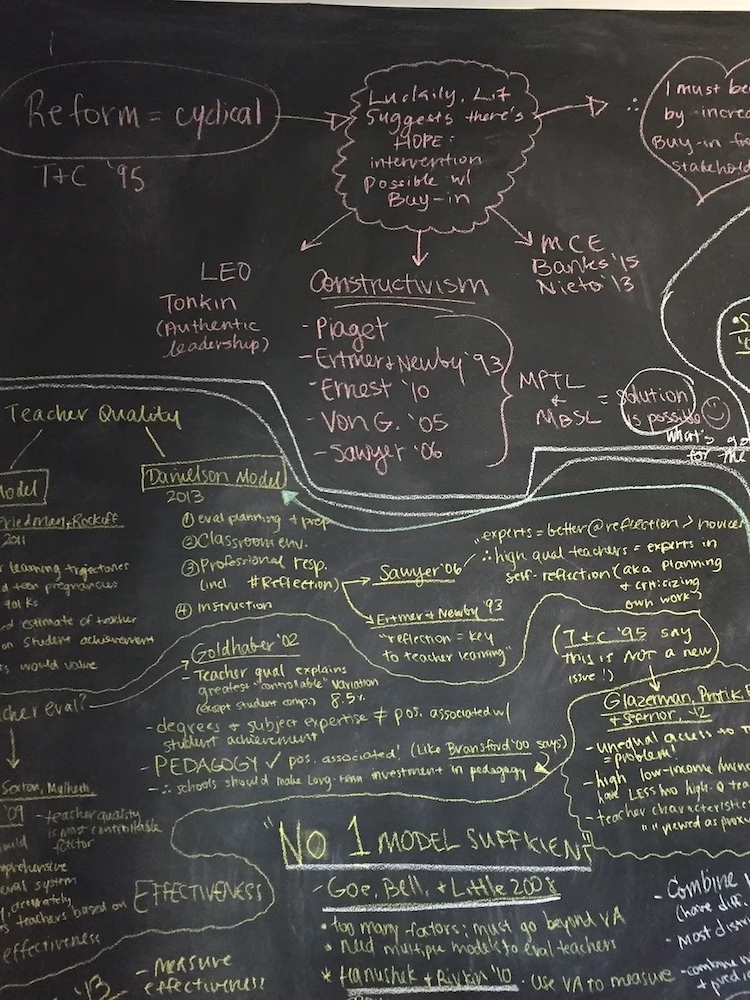
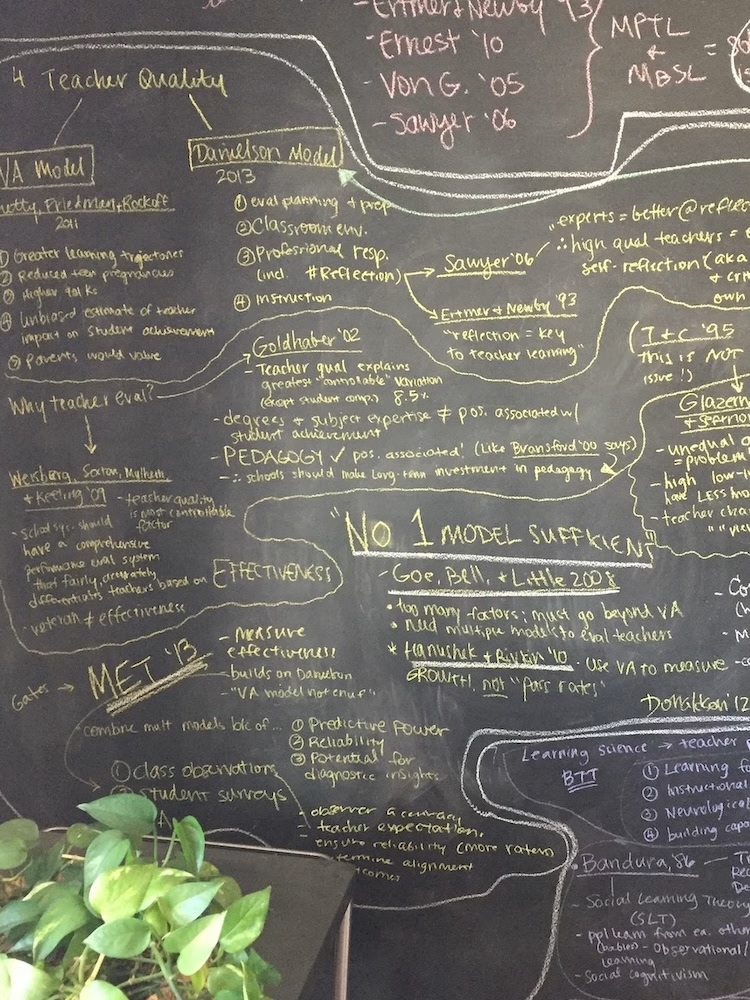
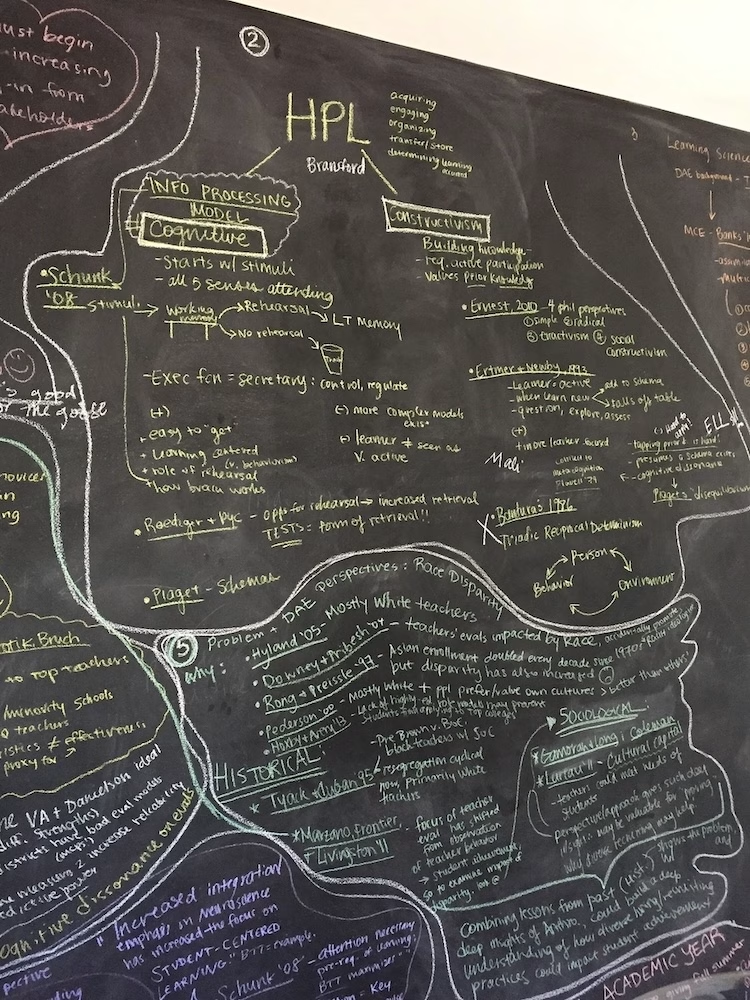
Over the years I’ve learned that while I initially absorb information well by reading, I have to organize my thoughts into maps of interconnected ideas to fully understand them, and then I need to have conversations about them (even imaginary ones) to fully soak in the juice. So I made these sprawling maps of citations and walked around having conversations with a chalkboard with a baby attached to me, and that’s how I studied for my doctoral comprehensive exams.
I’m writing this because when I was trying to figure out how to prepare for my comps, I mostly found tips about color-coded index cards and how to make sure you were undisturbed while studying. What worked for me was not what was being prescribed by anyone… so I’m sharing my strange chalk wall study method here.
What comps (doctoral comprehensive exams) actually are
If you’re not in a doctoral program: comprehensive exams are a high-stakes synthesis exam most doctoral programs require somewhere around the midpoint. You have to demonstrate command of your entire field’s literature: all the major theorists, the major frameworks and debates, and every methodology you might use. And they’re not multiple choice! They’re long-form, and can be written or oral or a combination (ours were oral exams). In my Ed.D. program at Johns Hopkins, comps were a multi-hour oral exam.
It’s not uncommon to fail your first attempt or even walk away from a program at this stage. But they’re a critical part of the process to figure out if you have enough expert knowledge of your field to actually do the abstract synthesis work the rest of the dissertation will require.
How I prepared for comps
I prepped for comps for over a year, and for months in that process, worked closely with a study group made up of me and three cohort-mates. We got together and had faux interviews about imagined potential exam topics and made connections between ideas through our conversations. We quizzed each other, organized ideas together, and generally just provided a lot of emotional support for one another.
There was a lot of reviewing, synthesizing, and being ready to have an in-depth discussion about a body of literature that itself took years to read and understand.
How the chalk wall came to be
My son was a few months old when comps prep started in earnest. He was not a baby who slept independently or could be put down for more than twenty minutes at a time. Generally he was a baby who wanted to be worn in a wrap to be content, and when he was content, I could study.
The chalk wall sort of happened by accident. During one of my study group’s sessions, we were organizing flash cards (which I also used to study!) by concept.
We were sitting at a table in my kitchen which was next to a wall in our home that was already painted with chalkboard paint (I’d been using it for things like ‘Happy Birthday so-and-so’ until then). I realized that day that the giant chalk wall we were sitting beside might be a good place to start organizing some of these ideas. So one day after a study group session, I started writing on it… and by the end of that first week, the wall was full.
How I studied using the chalk wall
It just so happened that the chalk wall turned out to be exactly what I needed:
- Once my ideas were up on the wall, I could review them while standing or walking with the baby
- The wall meant I wasn’t shuffling through index cards (which I also did at other times) so I had my hands free
- Because it was just there on the wall, I’d find myself reading the information constantly, like while making food or cleaning or doing anything else… there the chalk wall was
- And because it was a giant interconnected mindmap, it let me see and think about the entire scope of what I was learning at once, instead of one note card at a time
There was no rhyme or reason to how things were organized that would make sense to anyone but me. I wish I could say “the top right was frameworks by X; the middle was concepts around Y; the last one is things related to Z.” Yes, I had major theoretical frameworks for my field, with the names of the scholars associated with each in some areas, but those connected to some other ideas related to cultural competence and equity research (the heart of my own work). So ideas were tangled together and just sort of structured in a way that made sense in my head.
It wasn’t pretty and some of the writing was sideways because I ran out of room, and there were a lot of smudged parts, but it was all VISIBLE and I could easily see how everything connected, which I found to be really helpful and arguably better than my flashcards (although, again, I used both!).
Erasing the chalk wall
Around July (my exam was in September), I started having my husband quiz me on sections of the chalk wall.
Once I could discuss that section in-depth, and once I felt like “okay, I’m an expert on topic or concept X,” then we would erase that section of the chalk.
It was like the ultimate crossing-something-off-your-to-do-list thrill.
As we worked our way across the wall, we erased more and more areas (by this point I could cite the studies in my sleep). By the end of August 2016, the wall was clean. All the information had been transferred solidly into my brain.
My son turned six months old that same week, and the chalk-wall was put back to its intended use

By the time comps day came, I was not even remotely nervous.
Because I knew I knew everything I needed to know.
The comps themselves
…and I was right not to be nervous because I passed on my first attempt! Every question they asked, I felt thoroughly equipped to answer. They might as well have been asking me to describe my favorite books.
Still, I knew I was feeling that way during comps because of how much preparation went into it. That feeling, of knowing I was doing well while doing well, and then finding out officially that I passed remains one of the proudest moments of my life.
We pulled out the fancy champagne and I let myself sit on the couch for a full afternoon not studying anything, which had not happened in months.


The dissertation came after, and that had its own challenges.
But passing comps was a milestone. And it was the moment I knew (like yes I already knew but now I REALLY really knew) that I was actually going to finish this doctorate. Having that hard data point—I’ve passed my comprehensive exams—was like hard proof that I was really going to be able to do this.
Why I’m sharing my chalkboard study method
Because seeing other people’s stories helps!
I didn’t know so many other moms were getting through doctorates and studying in unconventional ways until way later. Once I did, the whole experience felt less weird and more like a shared reality. (I felt similarly the first time I nursed in public after seeing another mom do it. Sometimes you just need to see someone else doing the thing.) And people can’t seek out the people who are doing their version of the thing if those people don’t share their stories. So here you go! (I also wrote a short book called Toddler Weaning about my experience with weaning for the exact same reason. There wasn’t a ton of writing about it out there, so I added some.)
Also, because it worked for me.
If you’re prepping for comps right now
A few things I’d tell my comps-prepping self, if I could:
- Your study system doesn’t have to look like anyone else’s! Whatever works, works. If sitting at a desk works for you then do that, but if walking around your house reading a chalk wall works, do that instead. Or do both.
- Reading aloud is underrated. Especially for being able to discuss something in depth, you can’t just rely on reading things. You need to be hearing yourself TALKING about the material. This is doubly true if you’re doing oral comps.
- Make the ideas visible. Whatever your version of the chalk wall is (whiteboard, a giant sheet of paper, a digital mind map, a wall of post-its, find a way to see all of it at once. See image at the top of this post).
- Try moving while you study. Walking and pacing while talking and studying was helpful for me. Probably won’t suit everyone, but worth trying.
- Build the system around YOUR real life. Don’t try to do what you think a “real” doctoral student does. You are a real doctoral student. Do what works for you.
11. Bonus: Don’t forget to celebrate the victories
I had never studied and prepared for any exam the way I studied for my comprehensive exams. And then I did really well on them, and it was one of the proudest moments of my life.
I was also a new mom during this time, so taking the time (even like literally an afternoon) to mark the momentous occasion was a rare treat in this era of life.
If you’re working through an Ed.D. yourself, hang in there. You will cross the finish line, you will contribute valuable research to the field of education, and you will sleep again.
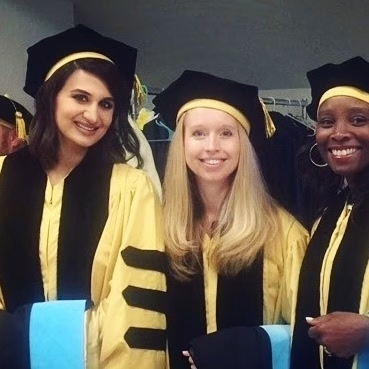
If you’re an Ed.D. candidate (or recent finisher) and you’re wondering what to do with your research now that the program is done, I’ve written about that here.
For more general resources on surviving doctoral work, The Thesis Whisperer remains an excellent resource on the PhD side of things.
A note on the contributors and on this post
This post is valuable thanks to the advice of a few classmates from an earlier cohort at Johns Hopkins. Thanks to Natalie Duvall, Kelly Galanis, and Nick Sproull for letting me republish your wisdom! Note that the bones of this post were originally written back in 2017; the post has been rewritten and republished here in 2024.
Questions
How do you survive an online doctorate?
Build relationships with your cohort, accept that the work is supposed to be hard, master APA early, work with your own habits and find a rhythm, keep searchable notes and reading records, get close to your advisers, focus on your problem rather than your solution, and celebrate milestones.
What are doctoral comprehensive exams?
A high-stakes synthesis exam most doctoral programs require around the midpoint, where you show command of your field’s literature, frameworks, and methods. They can be written, oral, or both; in Johns Hopkins’ Ed.D. program they were a multi-hour oral exam.
How did Punita Rice study for comps with a baby?
She mapped the literature on a chalkboard wall, read it aloud while wearing her son in a wrap, met with a study group of three cohort-mates, and erased each section once she could discuss it in depth. She passed on her first attempt.